
What is Tracheal Collapse?
As dog owners, we know that certain breeds are prone to certain health issues. For instance, golden retrievers are more prone to hip dysplasia, french bulldogs are more prone to spine malformations, so on and so forth. Small dog breeds have their own set of health issues - tracheal collapse being one of them.
Well, what is tracheal collapse?
Tracheal collapse is a chronic and progressive respiratory condition that obstructs the airway in dogs. The trachea, or windpipe, is normally held open by C-shaped rings of cartilage. As this cartilage weakens and collapses, the airway narrows, causing coughing, difficulty breathing, and potentially serious complications for affected dogs.
Causes
Tracheal collapse typically happens in one of three ways:
1. Congenital
Certain breeds (particularly small and toy breeds) are at a higher risk of tracheal collapse due to their size. Some of those breeds include Shih Tzus, Chihuahuas, Pugs, Malteses, and Toy Poodles.
2. Gradual
-
Excessive pulling on collars or strenuous activities like intense running or jumping can strain the trachea.
-
Exposure to irritants such as cigarette smoke or air pollution can weaken the trachea's lining and contribute to cartilage breakdown.
-
Older dogs (typically 5 years and older) are naturally more prone to tracheal collapse due to age-related degeneration of cartilage.
3. Sudden
Traumatic injury to the dog's neck area will also increase the risk of tracheal collapse.
Symptoms
Symptoms will vary depending on the severity of the collapse. The most prominent symptom is that the dog will have a "honking" cough. Other symptoms include difficulty breathing, gagging while eating or drinking, and in severe cases, a blueish tinge to the gums and tongue.
Diagnosis
X-rays can sometimes detect obvious tracheal collapses cases, but not always. It is often better to get a fluoroscopy - which is a moving x-ray - because that allows visualization of the trachea as the dog inhales and exhales.
Sometimes that is necessary to confirm an accurate diagnosis. Other methods include endoscopy, which give a view of inside the trachea using a tiny camera.
It's important to note that any disease of the upper or lower airway can be mistaken for tracheal collapse.
This includes a foreign object in the airway, laryngeal paralysis, elongated soft palate, infection of the trachea, and lung or heart failure.
X-rays of Tracheal Collapse
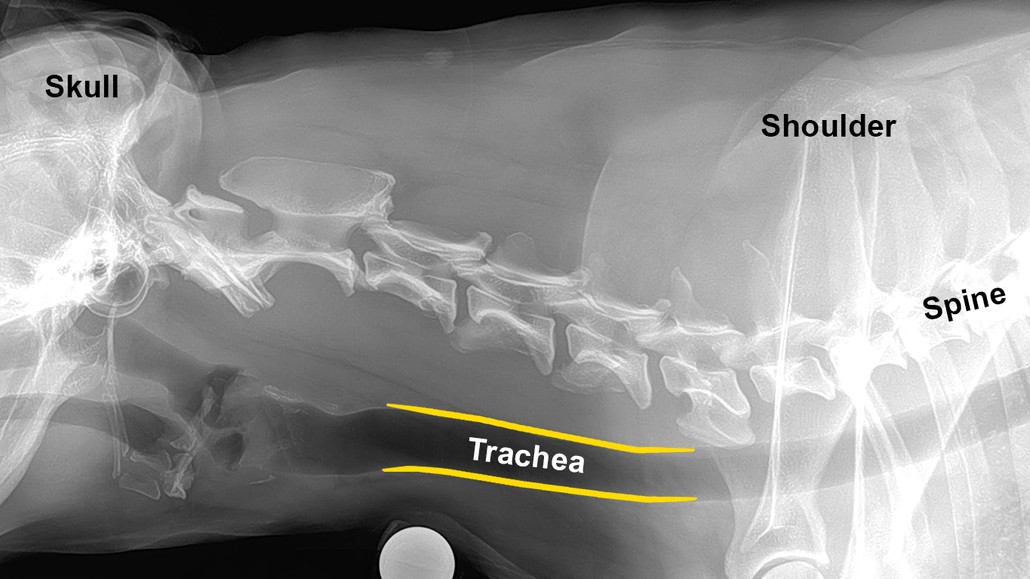
Healthy Trachea
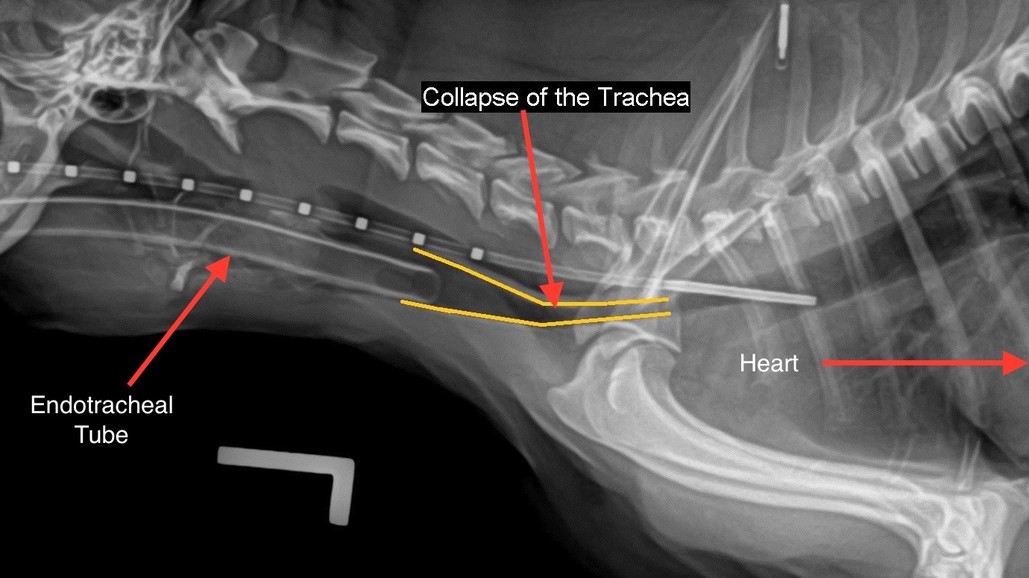
Collapsed Trachea
Treatment
Most cases of tracheal collapse are treated with cough suppressants, bronchodilators, corticosteroids, and/or antibiotics.
It's important to suppress the coughing because coughing irritates the throat, which then leads to more coughing.
If the dog is overweight, weight loss can also help the dog to breathe easier. Although treatment doesn't cure the disease, over 70% of dogs respond well to medical treatment of more than 12 months.
As you treat the dog, it is also recommended that the dog is in a smoke-free environment and free from other environmental pollutants.
It is also incredibly important to avoid anything that is around the dog's neck as this can put pressure on the dog's trachea.
This is even more important for dogs with a collapsing trachea that also have a tendency to pull.
For those reasons, a choke-free harness should be considered - like Gooby's patented Comfort X series.
How can a Comfort X Harness Help?

Avoiding the neck area is the key in mitigating tracheal issues.
Our Comfort X series of harnesses does exactly this with an "x" design that redistributes the pulling force of both the dog and the owner.
This patented design allows the harness to be choke-free and gives owners peace-of-mind knowing their dog will continue to breathe easily.
Let's See It In Action from
Our Very Own Ambassador Human & Dogs
Hana & Pepper
with
Jacqueline & Babe
with
Eloise & Bailey
with
Christina & Sumo
with